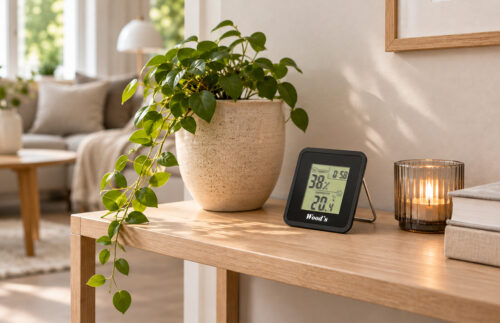
Did you know that humidity levels at home can affect more than just your house? High humidity can create conditions conducive to mould and a poorer indoor environment, whilst air that is too dry can irritate the eyes and airways. In heated living spaces, a relative humidity of around 40–55 per cent is often a useful guide, but what is appropriate depends on the temperature, the season and where in the house you are taking the measurement.
Humidity is usually measured as relative humidity (RH) and expressed as a percentage. It describes how much water vapour the air contains in relation to the maximum amount of water vapour the air can hold at the same temperature. Indoor humidity varies naturally throughout the year. In winter, the outdoor air is cold and contains less water vapour. When the air enters a building and is heated, the relative humidity drops, which can make the indoor air very dry, sometimes as low as 20 per cent. In summer, the air is often warmer and contains more moisture, which means that indoor humidity can rise to around 60 per cent or higher. Temporary fluctuations are not usually a problem, but if humidity is very low or high over prolonged periods, it can affect both our well-being and our home. Dry air can cause irritation to the eyes and airways, whilst prolonged high humidity can create conditions conducive to mould and damp damage. It is therefore important to monitor humidity levels and, where necessary, take steps to ensure a healthy indoor environment.
There is no single humidity level that suits the whole house. A heated bedroom has completely different conditions to a cool basement or a cold crawl space.
| Room | What is important to bear in mind? |
| Bedrooms and living rooms | Avoid prolonged high humidity. Check the ventilation and watch out for condensation and musty odours. |
| Bathroom | Humidity rises when you have a shower, but the moisture should be able to be ventilated away and the surfaces allowed to dry. |
| Laundry room | Wet laundry adds moisture to the air. Good air circulation and dehumidification can help the laundry dry faster. |
| Basement | Cool walls and ground damp can lead to high relative humidity. Monitor the moisture level regularly. |
| Garages and storage rooms | Temperature fluctuations, wet cars and damp storage can contribute to condensation and rust. |
| Attics and crawl spaces | Temperature and humidity conditions vary greatly. Assess the risk based on the building’s construction, materials and sources of moisture. |
An optimal relative humidity level is 50 per cent, but that said, it is not harmful to be above or below this level. However, if it becomes too high or too low over a prolonged period, both our health and our home can be adversely affected. In cold rooms, it is particularly important not to focus solely on the percentage of relative humidity. The temperature, the moisture content of materials and the duration of elevated moisture levels also influence the risk of damage.
When we talk about damp problems, many people think of discoloured walls, musty odours and damage to the building. But damp and mould can also affect the people living there. According to the Public Health Agency of Sweden, spending time in buildings with damp problems can lead to an increased risk of respiratory problems and respiratory infections. People with asthma may experience more symptoms, and even those without known allergies can be affected. Children are a particularly important group. Research compiled by the World Health Organisation (WHO) shows a link between damp damage in homes and an increased risk of developing asthma, particularly in children. This does not mean that every damp home causes illness. However, visible mould, a recurring musty smell and damp damage are signs that should be taken seriously. Another important point is that mould is not always visible or noticeable by smell. Damp damage may be hidden within the building’s structure.

The simplest way to monitor humidity is to use a hygrometer. It measures relative humidity and helps you see how it changes throughout the day and between seasons. But there are also warning signs that you can spot without a measuring device:
A hygrometer measures the moisture in the air, but cannot determine whether there is damp inside walls or floors. If you suspect damp damage, a more comprehensive damp survey may be needed.
Here you can read more about the signs to look out for and what you can do about it.
To get humidity under control, you first need to understand where the damp is coming from. We add moisture to the indoor air every day when we shower, cook and dry laundry. In addition, damp can seep in through, for example, the building’s foundations, the roof or gaps in the building envelope. You should therefore ensure that the ventilation is working properly, repair any water leaks and avoid allowing damp to linger for long periods. When ventilation is insufficient, a dehumidifier can be an effective solution. It removes water vapour from the air and helps to keep humidity under control.
Different spaces require different types of dehumidifiers. In a large, cool cellar, for example, you’ll need a model that can cope with lower temperatures and has sufficient capacity and air circulation for the entire space. Wood’s offers dehumidifiers tailored to different parts of the home, from bathrooms and utility rooms to cellars and crawl spaces. All these spaces have different damp problems and conditions, which is why you also need a dehumidifier with different features to really get rid of the damp problems in each space. Here at Wood’s, we’ll help you choose the right dehumidifier for the right place.


Remember: A dehumidifier can help prevent damp problems, but it is no substitute for measures to address water leaks or the remediation of existing mould damage.
Not necessarily. A temporary level of 60 per cent does not necessarily pose a problem. However, if humidity remains elevated for a long period, particularly near cold surfaces, the risk of damp damage may increase.
Yes, prolonged exposure to damp can create conditions conducive to mould growth. The risk depends, amongst other things, on temperature, materials and how long the damp remains.
Yes. The Public Health Agency of Sweden states that even people without known allergies can be adversely affected by spending time in buildings with damp damage.
There is no general range that applies to all homes. In areas with recurring damp problems, such as cellars and crawl spaces, it is wise to monitor the humidity regularly and pay particular attention during seasonal changes.
