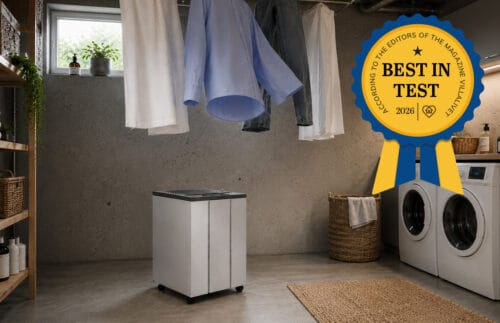
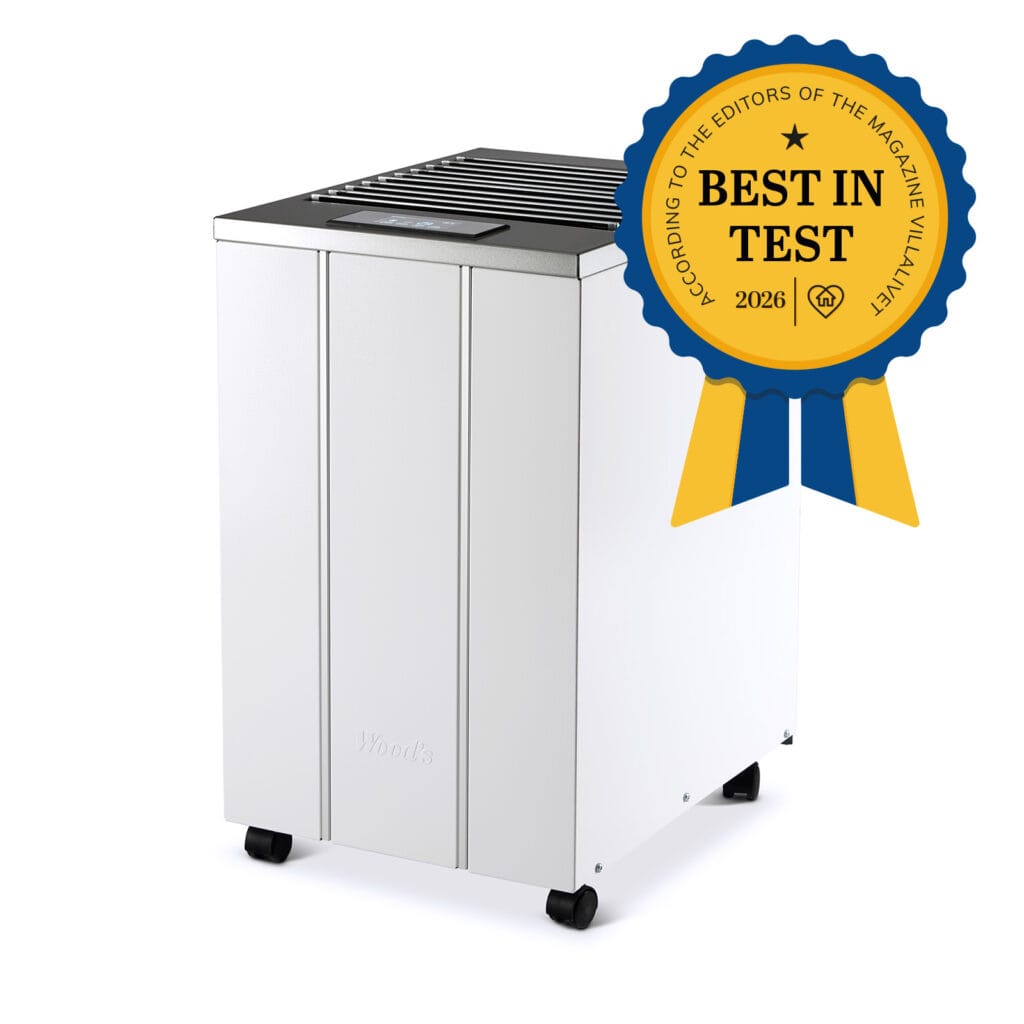
When Villalivet compared some of the market’s most popular dehumidifiers, Wood’s models came out on top in the test. Wood’s LD40 was named Best in Test 2026, whilst Wood’s SW59FM was highlighted as the obvious choice for larger areas and high humidity levels.
The result is particularly interesting for homeowners looking to solve common problems such as damp in the basement, musty odours, slow-drying laundry and poor air circulation.
Unlike standard living spaces, basements are often cooler, more prone to damp and have poorer air circulation. This means that many smaller dehumidifiers struggle to maintain a stable level of humidity.
To effectively dehumidify a basement, the following are essential:
It is also these characteristics that Villalivet chose to focus on in its test.
Which is the best dehumidifier for basements and laundry rooms? To answer this question, Villalivet compared several popular models based on characteristics such as airflow, capacity, energy efficiency and operating temperature. The test shows why Wood’s LD40 is one of the market’s strongest choices for basements and laundry drying, whilst the SW59FM excels for large areas, high humidity levels and restoration work.
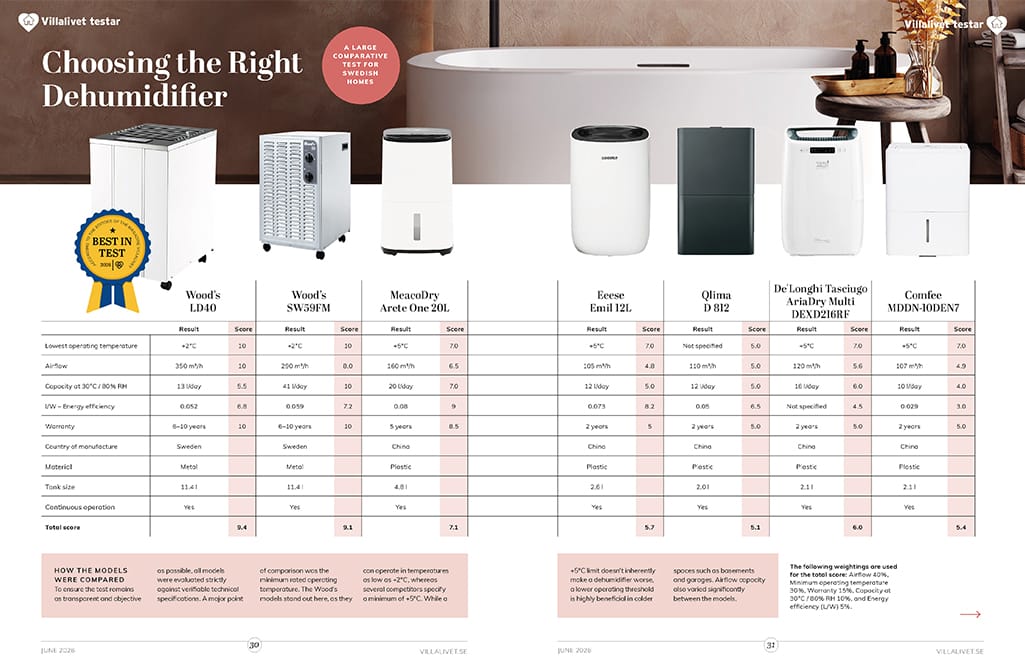
If you’d like to delve deeper into the results, you can read Villalivet’s full test comparison of dehumidifiers here. It starts on page 29 in the magazine.
In the test, the Wood’s LD40 achieved the highest overall score of all models. It stood out, among other things, for its high airflow of 350 m³/h, operation at low temperatures and long warranty period.
But what makes the LD40 particularly popular among homeowners is that it doesn’t just dehumidify – it also helps to dry laundry significantly faster.
When laundry is hung out to dry, large amounts of moisture are released into the air, causing the laundry to dry slowly. Wood’s LD40 blows dry air onto the clothes whilst removing the moisture from the air. The result is shorter drying times, no more musty smells in the clothes, less condensation and a more comfortable indoor climate.
Thanks to its high capacity and robust construction, the Wood’s SW59FM is not only used in basements. It is also a popular choice for flooding, water leaks and restoration work where large amounts of moisture need to be removed quickly.
With a capacity of up to 41 litres per day, the SW59FM is designed to handle demanding environments where smaller dehumidifiers are often insufficient. This makes it suitable for drying out damp-damaged areas, speeding up the drying process following water ingress and helping to reduce the risk of secondary damage such as mould and unpleasant odours.
For homeowners, this provides extra peace of mind – the same dehumidifier that keeps the basement dry all year round can also help out should an accident occur.

Just like the LD40, the SW59FM is made of metal and designed for continuous operation all year round.
When comparing dehumidifiers, many people look only at how many litres of water the machine can collect per day. But for basements, air flow and capacity are at least as important, if not more so.
If the air does not circulate throughout the entire space, moisture risks accumulating in corners, behind furniture and along cold walls. That is why both the LD40 and SW59FM are equipped with significantly higher capacity and airflow than many smaller dehumidifiers designed for domestic use.
This helps to create a more even and drier humidity level throughout the basement and provides better conditions for preventing mould, odours and damp damage.
In Villalivet’s major comparison, Wood’s models came out on top thanks to their combination of high airflow, low operating temperature, long warranty and robust construction.
For those who want the best all-round solution for basements and laundry rooms, Wood’s LD40 is the obvious choice. If you have larger areas or higher humidity levels, Wood’s SW59FM is designed to meet even tougher demands.
Sign up and receive tips about cleaner air, pollen, sleep, indoor climate and exclusive offers directly in your inbox.
"*" indicates required fields
A dehumidifier for basements needs to be able to handle low temperatures, high humidity and large air volumes. In Villalivet’s 2026 test, the Wood’s LD40 was named ‘Best in Test’ thanks to its combination of high airflow, high capacity, long warranty and being built to withstand basement conditions. The SW59FW is also built to cope with the basement environment.
Yes. A dehumidifier is an energy-efficient way to dry laundry indoors. A dehumidifier blows dry air onto the laundry whilst removing moisture from the room, which shortens drying time and reduces the risk of condensation and damp problems.
A musty smell is often caused by excessive humidity. When moisture remains for a long time, mould and microbial growth can occur, creating that typical basement smell.
Generally, a relative humidity of between 40 and 60 per cent is recommended. If the humidity regularly exceeds 60 per cent, the risk of mould, odours and damp damage increases.
No, a small dehumidifier cannot collect all the moisture present in the air in a basement. Nor can it dehumidify the entire space. It will collect water in the water tank, but it will not solve the damp problem in the basement.
The LD40 is designed for basements and laundry rooms where you want to combine effective dehumidification with faster laundry drying. The SW59FM is also designed for use in basements and is developed for larger areas, high moisture loads, and situations such as flooding, water leaks and restoration work. Both models are designed for use in the basement, but if you also need to dry laundry in the basement, you should choose the LD40.
Yes. After a flood or water leak, rapid drying is important to reduce the risk of mould and consequential damage. Powerful dehumidifiers such as the SW59FM are often used to speed up the drying process in basements, garages and other damp-damaged areas.
Yes. Both the LD40 and SW59FM are designed for continuous operation and are built from robust metal for a long service life and safe use in demanding environments.