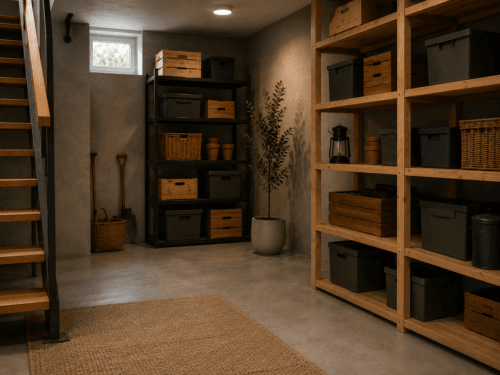
The basement is one of the most moisture-prone areas in the home. It is often situated wholly or partly below ground level, is cooler than the rest of the house and can be affected by both ground moisture and damp outdoor air. High humidity in the basement is therefore a common problem, particularly during the summer.
A dehumidifier for a basement needs to be sized to suit the basement’s size, temperature and moisture load. So don’t just look at how many litres of water the dehumidifier can remove per day. In a basement, the combination of high dehumidification capacity and high airflow is particularly important for controlling the humidity throughout the entire space.
There can be several causes of damp in the basement. For example, it may be due to damp outdoor air entering during the summer, ground damp, poor drainage, leaks, or moisture introduced through activities such as washing and drying. A dehumidifier can reduce the humidity, but if there is a structural problem or a water leak, the underlying cause must also be addressed.
Basement walls and floors are often in contact with or close to the surrounding ground. At the same time, the temperature is usually lower than in the rest of the house. This creates the conditions for high humidity in the basement. The problem can become particularly apparent during the summer. When warm, humid outdoor air enters a cool cellar, the air cools down. This causes the relative humidity to rise, and condensation can form on surfaces that are cold enough. This is why a basement can actually experience greater problems with damp on hot summer days, even though the weather outside feels dry and pleasant. If the humidity is too high for prolonged periods, it can create an environment where musty odours, condensation and mould are more likely to occur. In the long term, the damp can also affect building materials and items stored in the basement.
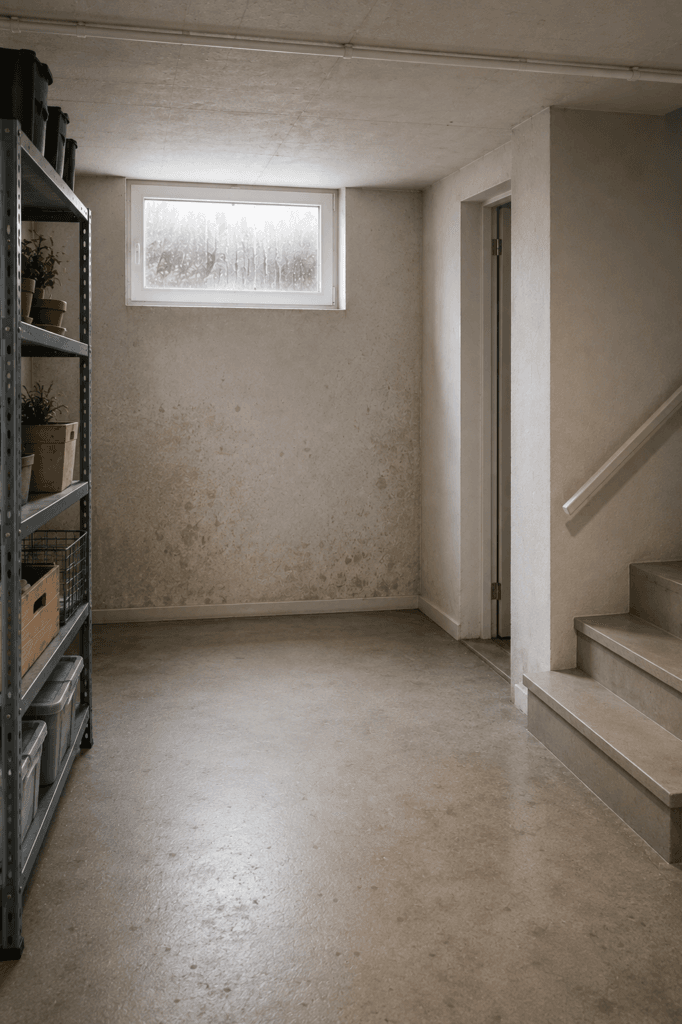
Relative humidity (RH) indicates how much water vapour the air contains in relation to the maximum amount it can hold at the current temperature. In a cellar, it is important to avoid prolonged periods of high relative humidity, as this increases the risk of mould, odours and other damp-related problems. As a guideline, a dehumidifier can often be set to around 50–55 per cent relative humidity in a basement. This provides a safety margin against levels at which conditions for microbial growth become more favourable. However, the exact suitable level may be affected by temperature, materials and how the basement is used.
A typical musty or earthy ‘basement smell’ may be a sign of damp problems and microbial activity. When materials such as wood, cardboard and textiles are exposed to high humidity for prolonged periods, this creates better conditions for microorganisms to grow. If the basement smells musty, or if you see condensation or notice dark patches, a good first step is to measure the humidity with a hygrometer. Be sure to take readings in several places, as humidity levels can vary between different parts of the basement.
A common mistake when choosing a dehumidifier for the basement is to simply compare how many litres of water different models can remove per day. Dehumidification capacity is important, but it doesn’t tell the whole story.
A basement is often a large and challenging space with several rooms, cold external walls, furniture and storage that restrict air movement. To control humidity, the dehumidifier must therefore be able to both remove sufficient moisture and circulate large volumes of air throughout the basement. If the dehumidifier has too low an airflow, it may reduce the humidity in the area closest to the unit, whilst more humid air remains in other parts of the basement – for example, in corners, behind furniture and along cold external walls. This can make the problem difficult to detect. The dehumidifier is running, water is collecting in the tank and everything appears to be working. However, even though water is being removed from the air, the relative humidity may still be too high in parts of the basement.
The result may be that musty odours, condensation and other signs of high humidity persist even though the dehumidifier is running. For a challenging space such as a basement, it is therefore not enough to simply look at the number of litres per day.
When comparing dehumidifiers, it’s easy to focus on how many litres of water they can remove per day. But in a basement, airflow is at least as important a factor to consider. Airflow, measured in cubic metres per hour (m³/h), describes the volume of air the dehumidifier can circulate. This is particularly important in a cellar, as the space is often large or divided into several rooms. Damp air can be found far away from the dehumidifier – for example, near cold external walls, in corners and behind furniture and storage units. To control the humidity throughout the entire cellar, the damp air needs to be able to circulate to the dehumidifier whilst the drier air is distributed back throughout the space.
So why is it not enough simply to compare dehumidification capacity? This becomes clear if we compare two dehumidifiers designed for completely different environments:
| Wood’s MRD14 | Wood’s Sw22FW | |
| Suitable for | Smaller heated spaces | Basement |
| Dehumidification capacity | Up to 12 l/day | Up to 13.5 l/day |
| Airflow | 113 m³/h | 350 m³/h |
The Wood’s MRD14 and SW22FW differ by just 1.5 litres per day in maximum dehumidification capacity. If you look solely at that figure, the models may therefore seem relatively similar.
However, the difference in air flow is considerably greater. The SW22FW circulates up to 350 m³ of air per hour, compared with 113 m³/h for the MRD14 – in other words, just over three times as much air. This is a crucial difference in a basement. A high airflow helps the dehumidifier draw in damp air from more areas of the cellar to pass through the unit, whilst simultaneously distributing the drier air further throughout the space. This reduces the risk of humidity levels dropping around the dehumidifier itself whilst remaining too high further away.
Put simply: dehumidification capacity describes how much water the dehumidifier can remove from the air, whilst air flow describes how much air it can circulate. For effective dehumidification of a basement, the dehumidifier needs sufficient levels of both.
Use a hygrometer and take readings in several places. This will give you a better picture of both the moisture level and whether certain parts of the basement are more affected than others.
Start by finding out how large an area the dehumidifier needs to cover. Also consider the layout – multiple rooms and closed doors make it harder to circulate air throughout the cellar. This is also linked to the dehumidifier’s capacity; if it can handle a larger area, it will remove moisture from the entire space more quickly.
Basements are often cooler than the rest of the house. The temperature affects the dehumidifier’s performance and is therefore important when choosing a model and dehumidification technology.
Don’t just look at litres per day. In a cellar, the dehumidifier needs to be able to remove enough water and circulate the air throughout the entire space.
A built-in hygrostat allows the dehumidifier to control its operation according to the set relative humidity, rather than running continuously regardless of need.
With regular use, continuous water drainage is practical. Condensation can then be channelled directly to a drain rather than having to empty the tank manually.
Continue to measure the humidity in several places after installation. If the RH is low around the dehumidifier but still high further away, this may be a sign of insufficient air circulation or that the dehumidifier is too small for the space.
See our range of basement dehumidifiers and compare models for different sizes and needs. All models in Wood’s SW series will solve damp problems in the basement, but those with a higher capacity will remove the damp more quickly and will also be more energy-efficient in the long run, as they do not need to run for as long.


Dehumidifier for basements, garages and attics

Dehumidifiers for basements, garages and attics

Dehumidifier for basements, garages and attics

Dehumidifiers for basements, garages and attics

Powerful dehumidifier for large basement and sanitation
In that case, you should buy a dehumidifier from the LD series. These are capable of removing all moisture from the entire basement, whilst also featuring a top vent that blows dry air onto your clothes. Your clothes will dry faster and you’ll have a dry, odour-free basement.
Dehumidifiers for drying laundry in basementsIf you recognise any of these problems, it may be a sign that your dehumidifier isn’t suitable for your basement:
Damp in the basement is common, as basements often combine cold surfaces, lower temperatures and proximity to the surrounding ground. A dehumidifier can help control humidity, but it is important to choose a model that is sized and designed for the environment. Therefore, do not focus solely on how many litres of water the dehumidifier can remove per day. Dehumidification capacity, airflow and performance at lower temperatures need to work together. With the right dehumidifier, you can keep humidity under control and reduce the risk of musty odours, condensation, mould and damp-related damage – throughout the basement, all year round.
This may be because the dehumidifier has too low a capacity or too low an airflow for the space. In a basement, it’s particularly important to choose a dehumidifier designed specifically for basement use. See our range of dehumidifiers for basements.
Measure the relative humidity at several points in the cellar. If the humidity reaches the desired level near the dehumidifier but remains high in other parts of the cellar, air circulation may be insufficient or the dehumidifier may be undersized.
Generally, a relative humidity of between 50–60% is recommended to reduce the risk of mould, odours and damp damage.
It depends on where the dehumidifier is located. In basements, crawl spaces and garages, we recommend running the dehumidifier all year round, but Wood’s dehumidifiers have a built-in hygrometer and will only operate when the humidity exceeds the set relative humidity level (around 50%).
Yes. Musty odours are often caused by high humidity. As the humidity decreases, the odour usually improves as well.