Museums hold the history and knowledge of our world. They are a culmination of sanctuary and school, a place to reflect, research, and admire. They also play a crucial role in conserving local culture, ancient art, and antiquities through careful documentation and artefact preservation.
Museums manage our shared cultural heritage. They protect not only works of art, archives and historical objects, but also stories, memories and identities that span generations. Preserving these priceless objects requires carefully controlled climatic conditions – and one of the most crucial factors is stable humidity.
Dry air and rapid variations in relative humidity (RH) are currently one of the greatest long-term risks to museum collections. Many objects are not kept in climate-controlled display cases, but are exposed in open halls, churches, storage rooms and temporary exhibitions where the indoor air directly affects the materials. When the humidity drops too low or varies greatly, tension builds up in the materials, which can lead to damage that cannot be repaired afterwards.
Many of the materials that museums manage are organic and react directly to changes in humidity. When the RH level drops, the materials begin to release their bound moisture, which can cause both visible and structural damage over time. Wood shrinks, paper becomes brittle, textiles lose their elasticity and paintings risk cracking and flaking.
For materials such as wood, leather, textiles, bone, glue and historical pigments, even relatively short periods of dry air can cause permanent deformation. These changes often occur slowly and are only noticed once the damage has already been done, which makes preventive climate control crucial in museum environments.

Not all humidifiers are suitable for sensitive cultural environments. In museums, archives and churches, it is crucial that humidification is carried out in a controlled and safe manner, without introducing particles or risking over-humidification.
Ultrasonic humidifiers can, if distilled water is not used, spread microscopic mineral particles into the air. These can settle as a fine layer of dust on works of art, display cases and technical equipment – something that both increases the need for cleaning and risks damage to sensitive surfaces.
That is why evaporative humidification is used in Wood’s Vienna HSW100. The technology mimics nature’s own evaporation process and only adds the amount of moisture that the air can carry. The result is even and stable humidity without mist, condensation or particle dispersion. At the same time, the water is filtered through antimicrobial filters that capture minerals and impurities, providing clean and safe humidification – suitable for long-term preservation.
Museums are dynamic environments where exhibitions change, objects are moved and rooms are used in different ways over time. Climate conditions can therefore vary greatly between halls, storage rooms and temporary exhibitions. Permanent humidification systems often lack the flexibility required in this reality.
Wood’s Vienna HSW100 has been developed to meet precisely these needs. It is powerful enough to handle larger exhibition areas and open halls, but at the same time portable enough to be moved between zones when climate requirements change. This makes it possible to quickly stabilise humidity where it is most needed and reduce the risk of stressful moisture differences when objects are moved between different environments.
Wood’s Vienna HSW100 is manufactured in Sweden and constructed from galvanised steel, making it robust, hygienic and suitable for continuous operation in professional environments. It is designed for operations where reliability, low energy consumption and minimal maintenance are crucial.
Summary – long-term protection for cultural heritage and collections
Dry air and unstable RH levels are one of the biggest long-term risks to museum objects. By taking a preventive approach to humidity control, museums can reduce wear and tear on sensitive materials, reduce the need for conservation efforts and create a more sustainable preservation climate.
With Wood’s Vienna HSW100, museums get a safe, flexible and professional climate control solution, developed to protect art, archives and historical objects – today and for future generations.
Contact us for advice on Wood’s Vienna HSW100. We will help you assess your needs, location and the right solution for your premises and collections.
henrik.fernsund@woods.se
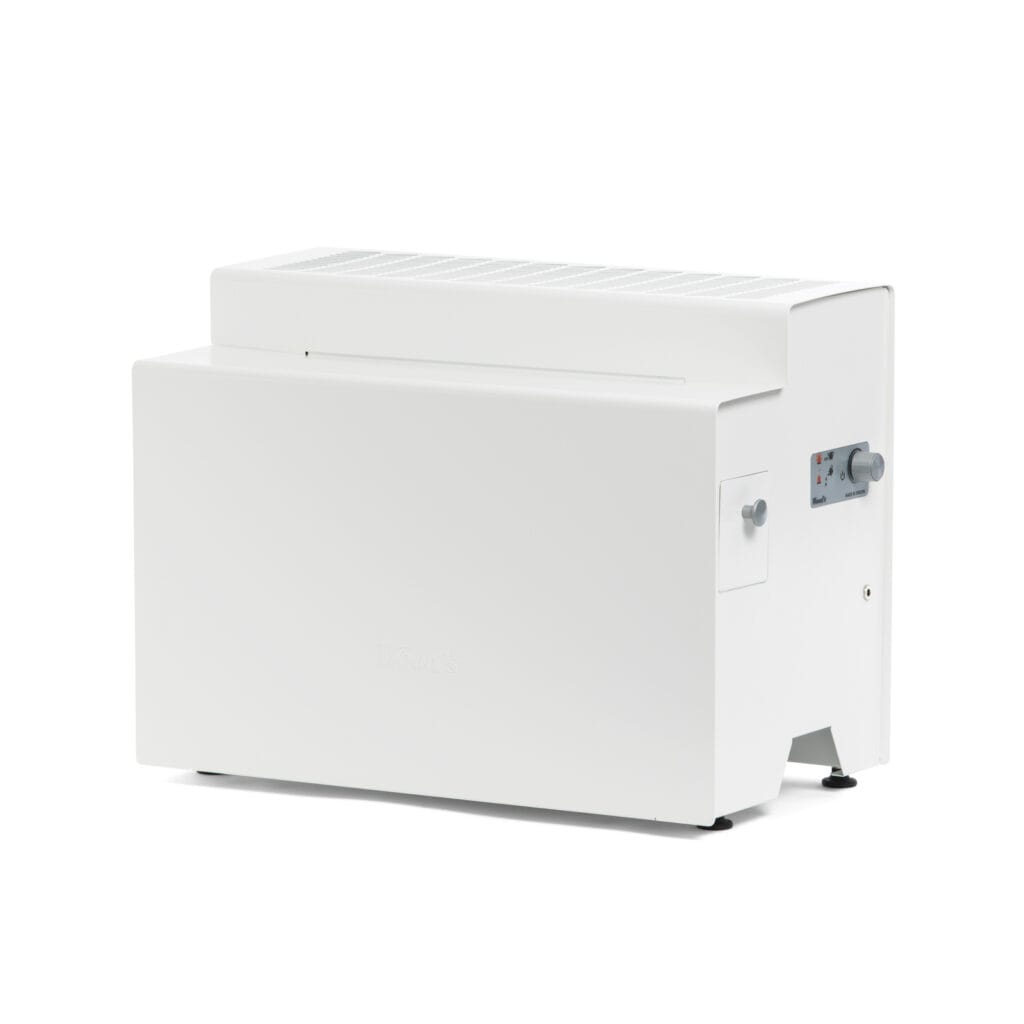
Humidifier for large premises and open-plan spaces

Filter for the Vienna HSW100 humidifier
Humidity is crucial for preserving art, artefacts and building materials. Too dry air can cause cracks, drying out and deformation in wood, paintings, textiles and paper. Stable humidity reduces the risk of permanent damage and extends the life of collections and fixtures.
The recommended relative humidity in museums and galleries is usually between 45–55% RH. However, the most important factor is stability – rapid fluctuations in humidity are often more damaging than a slightly deviating average value.
Dry air causes organic materials to lose moisture and shrink.
This can lead to:
During winter, the outdoor air contains very little moisture. When this air is heated indoors, the relative humidity drops sharply. In older buildings, churches and museums with large air volumes, the humidity can fall to 20–30%, which is well below safe levels for sensitive materials.
Both too low and too high humidity can cause damage.
Humidity is measured with a hygrometer or climate logger. For museums, continuous monitoring is recommended so that changes are detected in time. Measurements should be taken both in exhibition rooms and in storage areas, as the climate often differs between different parts of the building.
Yes, but it is important to use professional, evaporative humidifiers that add moisture in a natural and controlled way. These minimise the risk of condensation, dripping and the spread of particles – something that is crucial in sensitive cultural environments.
Evaporative humidification mimics nature’s own process and only adds the moisture that the air can carry. This provides:
Damage from dry air often occurs gradually but can begin after just a few weeks of low humidity. Repeated seasonal variations – year after year – are particularly harmful and can lead to permanent structural changes in the materials.
By combining: